How do we rank and evaluate relationships to help you stay in touch with your contacts

Nat is a relationship management app. We help our users stay in touch with the people they meet. Analyzing data, understanding and evaluating relationships is at the core of our business. In this article, I'd like to share how we think about this and how our app works in the background. Let's start with the first question: what is a relationship?
Just to clarify, we mean "relationship" in the general sense. There is a relationship between two people who know each other. We're not talking about being in love.
What is a relationship
If you've used your email address for more than a year, you've most likely interacted with over 1'000 email addresses. Some as friends, colleagues and people you met, many are newsletters and informational emails and most are transactional emails such as flight tickets, purchase confirmations, delivery updates, ...
What this means is that most of the emails that come to your inbox are not sent by contacts of yours. Here is how we decide who's a contact of yours, and who's not.
Relationship criteria: what it takes to be your contact
We consider that the relationship needs to be bi-directional. If you're someone's contact, he should be your contact as well. Basically, what this means is that you both need to have sent at least one email to the other. Besides, we'll also look at the ratio of sent emails versus received.
For example, you might have replied once to a marketing email but they emailed you two-hundred times. This ratio would suggest that this is not really a relationship, and that's how our app will view this as well.
How do we measure relationship strength
There is an infinite way in which relationships are created. There are as many ways in which they discontinue.
Our general thesis is that at some point, relationships become stable and that in order to continue, this stable rhythm and intensity needs to be maintained. For now, our app only measures the number of interactions and the strength of interactions in a basic way (meeting is more intense then sending an email)
To give you an example, you might meet someone at an event, chat every day for a week regarding a potential project, start the project and finish it a month later. From there on, you stop interacting daily and meet or exchange once per month.
Here is how our AI would understand the relationship over time:
- In the first weeks, you'd be really in touch, but if you stop interacting for more than two days, you'll start to lose touch
- After the project, you'll start to lose touch after a week or two
- Once the relationship has stabilized, you'll only lose touch after not interacting for over a month.
As a reminder, relationship strength is shown through the coloured bar in the contact view. Green means you're in touch and red means you're totally losing touch.
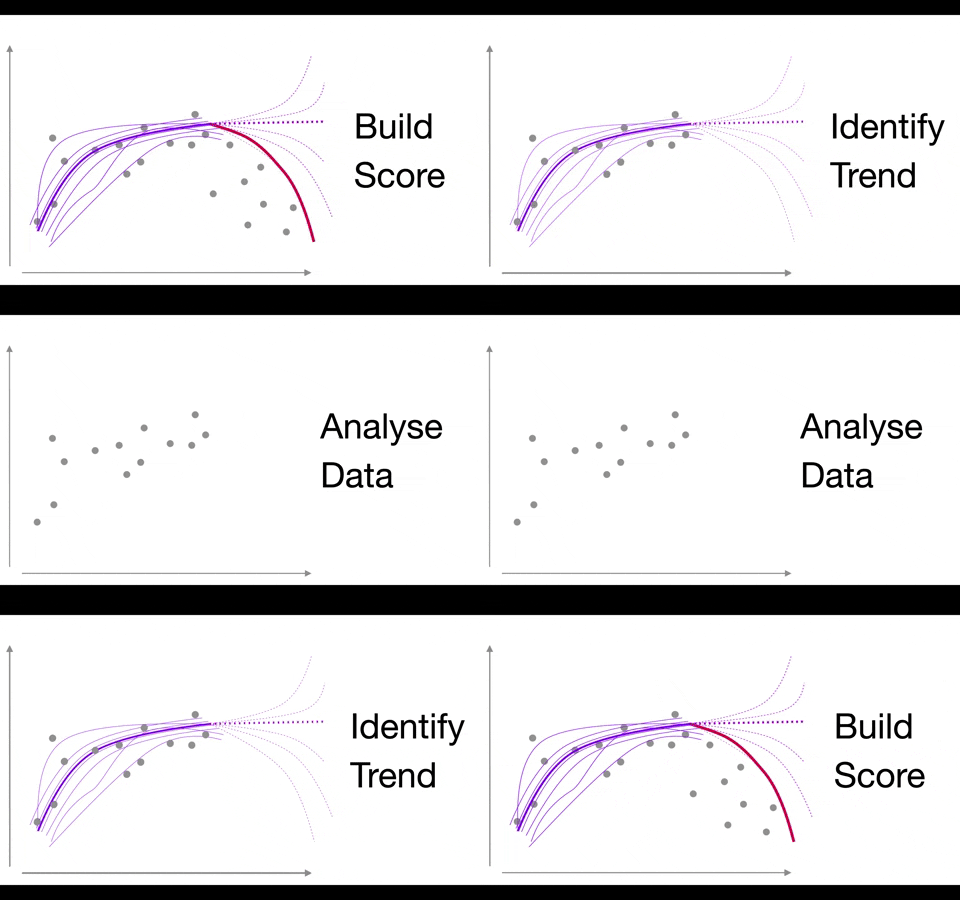
The way it works is that our app will figure out a trend for every stage of the relationship based on your data. Using this trend as a baseline, our app will compare it with your data to see if the trend is continuing or if you're not communicating enough (in which case you'd be losing touch). Here is a short animation:
We're happy to answer any additional questions you might have!
This article will be adjusted as our app becomes more complex

